International wholesale sourcing · Market-specific assortments
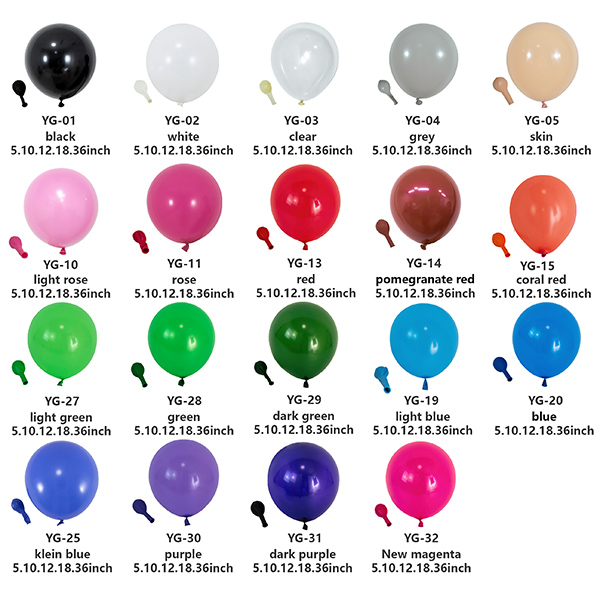
Choosing balloon products for different global markets starts with the destination country, the sales channel, and the exact balloon configuration—not an assumed national bestseller list. Importers and party-supply distributors should establish which balloon sizes, finishes, packaging formats, and safety requirements fit their customers before committing to a wholesale order. For example, buyers considering wholesale matte latex balloons for regional retail assortments can compare approved sizes, color references, pack quantities, and local sales evidence before selecting stock.
Borun Balloon Factory, operated by Xiongxian Borun Latex Products Co., Ltd. in Hebei, China, has manufactured balloons since 2006. Its wholesale range includes pure natural latex balloons, foil balloons, thermoplastic polyurethane (TPU) Bobo balloons, and balloon arch kits. Buyers evaluating wholesale foil balloon assortments for import and distribution face different variant minimums, inflation requirements, and packaging decisions from those buying latex balloons. This guide provides a purchasing method for comparing these categories, without treating preferences in the United States, Europe, or Oceania as universal market facts.
Quick Reference: Build a Market-Ready Balloon Assortment
A product is not purchase-ready when its destination, intended use, packaging, applicable compliance records, or approved sample reference is still unresolved.
1. Start with the Country, Sales Channel, and Evidence of Demand
A national market is too broad to function as a purchasing specification. A retailer selling party supplies in Germany and an event-decoration company operating in Germany may require different balloons even though both orders enter the same country. The retailer must consider shelf space, saleable pack counts, product labeling, and reorder frequency. The event company is more likely to judge a product against the appearance of an inflated installation, accessories, and color consistency across the planned decoration.
Instead of assuming that pastel latex balloons sell best in one country or number foil balloons sell best in another, compare measurable evidence from the actual sales channel. Useful evidence can include a retailer's previous orders, point-of-sale records, online sell-through, search and listing performance, current customer requests, and the sales performance of competing product formats. These sources answer different questions; none alone proves national demand.
| Buyer channel | Potential balloon category | Evidence to request | Approval condition |
|---|---|---|---|
| Party-supply retailer | Latex balloon color and size packs, standard foil balloon designs | Sales by size, color, pack count, and seasonal period | Approved variants fit shelf space and realistic reorder volume |
| Online party-products seller | Balloon arch kits, defined retail-ready sets | Actual listing demand, buyer feedback, return reasons, and pack economics | Complete kit and packaging can be sold as the proposed listing |
| Event-decoration distributor | Latex finish and size assortments, selected foil accents | Customer installation plans, repeat color requests, and sample trials | Inflated appearance and usable components match client requirements |
| Corporate promotional distributor | Custom printed latex balloons | Approved brand artwork, campaign quantity, and event deadline | Artwork feasibility and production schedule are confirmed |
2. Compare Real Balloon Configurations Before Setting an Assortment
Wholesale balloon procurement should compare defined purchase units rather than generic category names. For example, "foil balloons" does not indicate whether the order involves an existing number style or a newly developed shape. Likewise, "balloon arch kit" does not establish the quantities of individual balloons or accessories inside a retail pack.
| Balloon category | Product details to select | Standard purchasing baseline | Critical sample or order check |
|---|---|---|---|
| Latex balloons | Pure natural latex; 5, 10, 12, 18, or 36 inches; matte, metallic, macaron, pearl, or retro finish | 5,000 pieces standard minimum; final color and pack split confirmed for the specific order | Approved size-specific gram weight, inflated color, visible defects, and pieces per pack |
| Stock foil balloons | Existing shape, size, color, valve, and inflation use | 100 pieces per style, size, and color; normally two bags of 50 pieces; no assumed mixing across variants | Shape, seam, valve performance, exact variant and retail packing |
| TPU Bobo balloons | Transparent Bobo size, presentation, decorations or approved custom design | 100 pieces for standard stock Bobo balloons; 5,000 pieces per design for custom printed or custom shape orders | Clarity, inflation suitability, print placement when applicable, and complete packing |
| Balloon arch kits | Exact balloon quantity, size mix, colors, accessories and instruction pack | 30 complete sets for stock or custom kit orders | Component count, representative balloon inflation, color mix, and test assembly |
These minimums describe different commercial units: individual balloons, printed designs, product variants, and complete kits. A retailer should not calculate a mixed-category order by adding all balloon pieces together and assuming the result satisfies every applicable minimum. Customized foil shapes, printed balloon designs, and special kit components can introduce separate feasibility or minimum-quantity requirements.
3. Check Destination-Market Rules Before Approving Balloon Packaging
Market-entry review begins by identifying the intended consumer, product classification, finished balloon configuration, and importer responsibilities. A loose latex balloon, an electronically illuminated Bobo balloon, and an arch kit containing accessories cannot automatically share the same testing or labeling determination.
The following market examples describe regulatory checkpoints current as of October 2026. They are purchasing prompts, not a universal certificate list or a replacement for destination-specific regulatory assessment.
| Destination | Regulatory checkpoint | Buyer action before approval |
|---|---|---|
| United States | Determine whether the finished balloon product is a children's product subject to applicable Consumer Product Safety Commission rules, certification, warnings, and electronic filing. | For covered imported children's products, obtain applicable laboratory results; the importer must arrange the Children's Product Certificate. Verify current filing obligations. |
| European Union | For products classified as toys, review applicable toy safety requirements, CE marking, safety assessment, and the relevant EN 71 test scope, including latex-related chemical tests where applicable. | Confirm product-specific evidence, importer details, warnings, language requirements, and the applicable transition rules for the new Toy Safety Regulation. |
| Great Britain | Eligible toys can be placed on the Great Britain market using CE or UKCA marking under the applicable conformity arrangements. | Confirm the route used, manufacturer and importer details, documentation, and warnings; do not assume UKCA is always mandatory. |
| Northern Ireland | Different toy conformity-marking rules apply from Great Britain, including CE and, under particular assessment arrangements, CE plus UKNI. | Record Northern Ireland separately from Great Britain when checking marking, assessment and importer obligations. |
| Australia | Check the actual category under Australian consumer product law. The specific mandatory standard for balloon-blowing kits concerns tube-and-glue-like-substance kits, not ordinary latex balloons generally. | Confirm applicable safety, warnings and labeling for the exact imported configuration; do not assign the kit-specific chemical rule to unrelated balloons. |
| New Zealand | New Zealand product safety and category-specific requirements must be assessed separately. Balloons are expressly excluded from its specific under-36-month children's toy standard. | Check other applicable safety obligations and any components included in a balloon kit. Do not infer that the exclusion makes an unsafe product acceptable. |
For latex balloon chemical testing, buyers should request the actual applicable report and confirm the tested model, test method, result, date, and relationship to the intended purchase. EN 71-12 standard criteria and EU legal limits are not interchangeable. This guide intentionally does not present one numerical nitrosamine limit as universally applicable to every balloon and every regulatory period.
4. Turn the Market Requirements into a Purchase Specification
After identifying a possible assortment, the purchasing team should create a written record for each destination-market product configuration. The record should make it possible for Borun to quote the actual balloon and for the buyer to approve the finished retail presentation.
Product Specification Record
Record the balloon category, exact size, applicable size-specific gram weight for latex balloons, finish, color reference, inflation method, printed design where applicable, quantity per variant, and components of each complete kit.
Destination and Label Record
Record country or submarket, intended consumer, category classification, warnings, label language, manufacturer and importer information, barcode, pieces per pack, and applicable test-report references.
The sample specification and label record should point to the same product version. For example, changing a balloon arch kit from a decoration-only configuration to a different component mix may require a new evaluation of accessories, labels and applicable tests. Changing a foil balloon shape or valve configuration may require different sample checks from merely reordering an existing color.
Need a Product and Packaging Feasibility Review?
Send Borun the destination country, sales channel, proposed latex, foil, TPU Bobo or arch-kit configurations, target quantities and preliminary labels. Ask which physical samples, manufacturing specifications and supporting records can be reviewed before selecting the final assortment.
5. Compare Samples Against the Approved Market-Specific Requirements
A wholesale balloon sample should be evaluated as the product will actually be sold or used. A supplier photograph cannot establish leak performance, actual inflated color, label accuracy, or whether a balloon arch kit contains every agreed component. Use a reference sample and a written acceptance checklist for the exact variant.
| Product being checked | Method and reference | Decision if the sample differs |
|---|---|---|
| Latex balloon of an approved size and finish | Inflate to the agreed condition; compare color, visible defects and actual size-specific weight against the signed specification. | Reject the sample reference or revise the written specification before bulk production. |
| Specified foil balloon variant | Check shape, dimensions, valve function, seam condition and intended inflation method. | Request corrected construction or a replacement sample. |
| Selected TPU Bobo balloon | Inspect transparency, the approved dimensions, inflation behavior and any applied artwork. | Reconfirm the Bobo configuration and repeat the affected trial. |
| Complete balloon arch kit | Count the actual balloons by size and color, inspect accessories, and test assembly against the approved kit contents. | Correct missing components and repeat the assembly check. |
| Retail pack for the stated market | Compare label language, warning content, pack count, variant identifier and packaging sample to the approved record. | Hold packaging release until artwork and labeling are resolved. |
A latex balloon's gram weight is one dimension of specification consistency, not proof of overall quality. Inflation, leakage, color, product completeness, and the agreed test conditions require separate evaluation. For each production batch, request inspection results that identify the actual product, approved size or configuration, sample reference, test method and acceptance outcome.
Borun's usual sample preparation period is 3–5 working days, and standard bulk production generally requires 5–15 working days after applicable approvals. These are manufacturing-stage references, not guaranteed arrival times in the United States, Europe, Australia or New Zealand. Freight, customs, additional testing, translations and customized packaging can affect the final delivery plan.
6. Do Not Convert Unverified Market Assumptions into Bulk Orders
Some purchasing decisions can be supported by manufacturing specifications. Others require the importer to establish actual local commercial demand. Treat these evidence types separately when deciding whether to proceed.
Proceed When
The sales channel and demand evidence support the chosen variants; the destination classification and required documents are identified; product and packaging samples match approved specifications; and minimum quantities and delivery terms are commercially acceptable.
Pause When
The choice depends on an unsupported national bestseller claim; label or importer responsibilities are unclear; the report covers another product; a new component has not been tested as required; or the actual minimum order quantity would create an unacceptable inventory commitment.
An initial assortment can use a small, documented group of variants, but it must still respect each balloon category's minimum order quantity and packaging requirements. The number of variants should follow the buyer's own expected sell-through and replenishment plan, not an invented rule that all European importers buy fewer styles or all American retailers favor variety packs.
7. Request a Destination-Specific Wholesale Balloon Quotation
Once the proposed market assortment has passed demand, product, compliance and sample review, the buyer can request an itemized quotation. Different balloon categories should remain separate line items so the supplier can evaluate each quantity, customization requirement and packing route.
- Destination: country, submarket if relevant, and intended sales channel.
- Products: exact latex balloon size/finish, foil style, TPU Bobo configuration, or complete arch-kit specification.
- Quantity: purchase quantity by design, style, size, color or complete kit; identify expected reorder volumes separately.
- Packaging: units per pack, approved label and warning artwork, barcode, carton identification and private-label requirements.
- Approval evidence: sample version, applicable testing requirements, destination-specific documents and unresolved exceptions.
- Commercial details: target delivery date, destination, shipment arrangement and payment terms for the quoted order.
Borun Balloon Factory manufactures latex balloons and provides the relevant foil balloon and TPU Bobo balloon manufacturing and supply routes described in its official product information. Complete balloon arch kits are assembled and supplied against an approved component list. For customers requiring branded bags, header cards or retail boxes, Borun coordinates customized balloon packaging through a long-term affiliated packaging factory rather than claiming to manufacture the packaging in-house.
Ready to Review a Market-Specific Wholesale Order?
Provide your country, channel, exact balloon variants, quantities, approved samples, packaging requirements and destination-market documentation questions. Borun can review the supply configuration, applicable minimums and manufacturing schedule before issuing a quotation.
Frequently Asked Questions
Can a wholesaler use the same balloon assortment for the United States and European Union?
Some balloon designs may be commercially suitable for both destinations, but legal classification, warnings, importer details and supporting documentation must be reviewed separately. A shared product image or factory catalog does not establish compliance in either market.
Does a CE-marked balloon automatically qualify for the British market?
Great Britain recognizes CE marking for eligible toys under the applicable conformity arrangements, but the product must still satisfy the relevant rules. Northern Ireland has a different framework and must be checked separately.
What if a balloon sample passes but the retail label is incomplete?
The purchaser should withhold packaging approval, identify which destination-specific label requirements are missing, revise the artwork and confirm the corrected pack before bulk packaging is released.
When should a buyer request a new balloon sample or further testing?
Reassess the evidence when a relevant size, material, printed design, balloon shape, valve, kit component, labeling arrangement or applicable destination rule changes. The decision should be recorded against the actual product and existing report scope rather than applying a previous approval automatically.
Can low-volume market testing combine every balloon type under one minimum order?
No universal combined minimum applies. Standard latex balloons, stock foil variants, stock TPU Bobo balloons and complete balloon arch kits have different starting quantities. Custom printing or new shapes can introduce separate design-level requirements. Request a quotation broken down by the actual variants.
How can an importer avoid repeating an unsuccessful assortment order?
Track sales by the exact balloon size, color, finish, pack format and channel. Compare the result with the original demand assumption, retained sample and delivered specification. Change the next assortment only when the evidence supports the revision, and record whether new labeling or sample approval is required.
Procurement note: country examples are regulatory review checkpoints and product selection methods, not national sales rankings or a guarantee of legal market access. Importers should verify requirements in force for the actual balloon configuration and intended market before committing to the wholesale purchase.